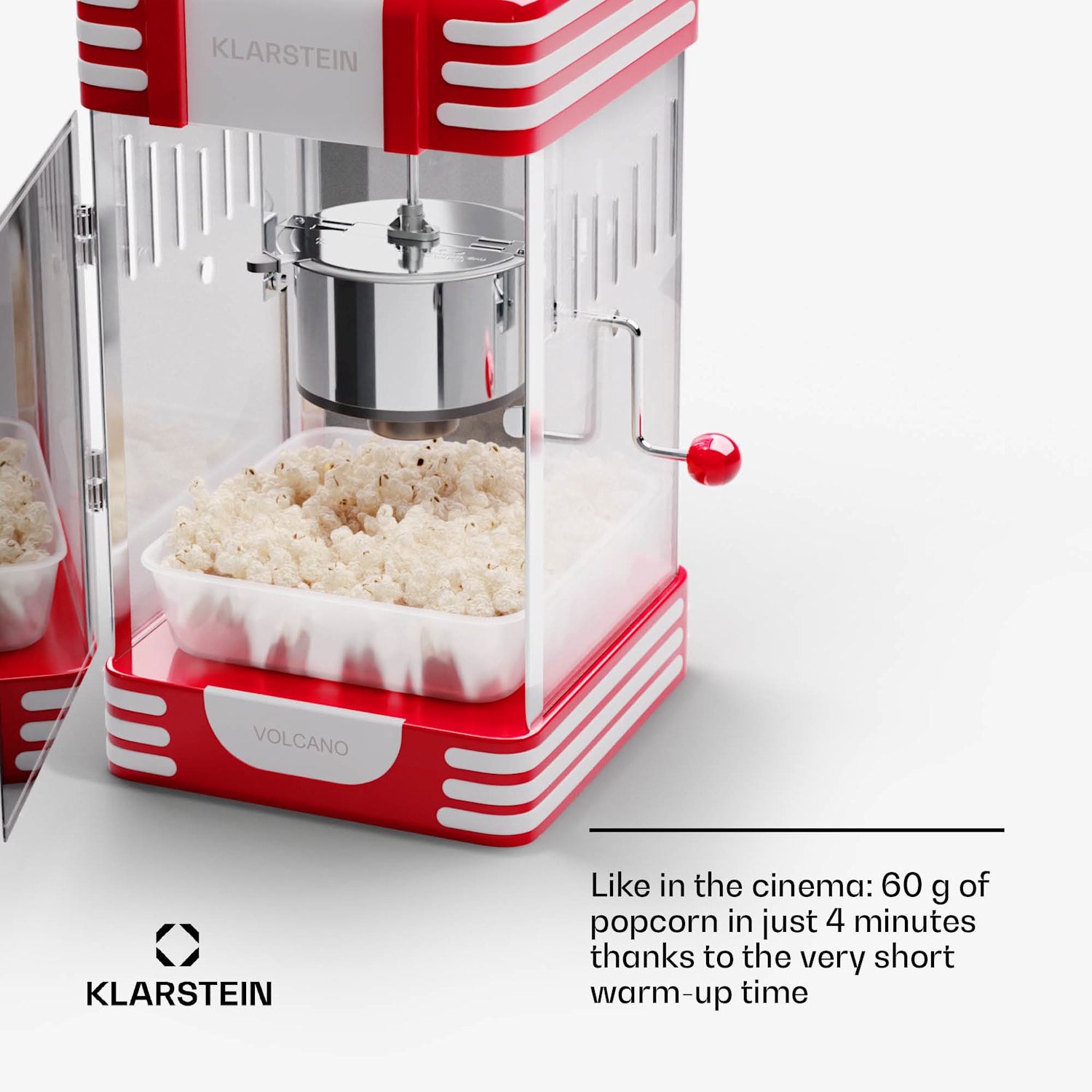
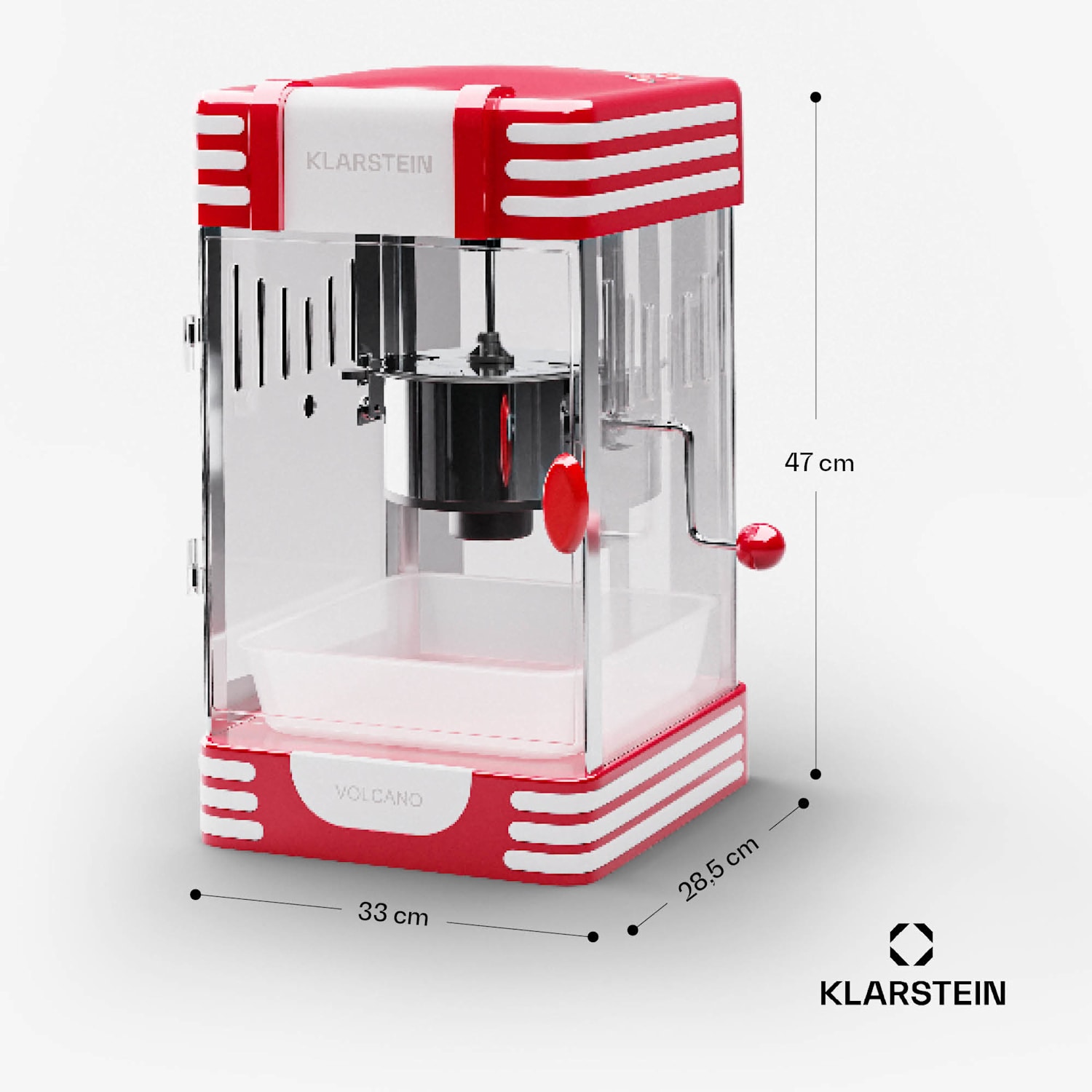
Ich habe mir sehr viele Popcornmaschinen angeschaut und ungefähr hundert Bewertungen gelesen. Eine Entscheidung ist wirklich sehr schwer, denn bei den mit sehr gut bewerteten Maschinen stellte sich oft nach einem Jahr heraus, dass der Kessel nicht mehr heiss wurde, anscheinend wurde hier auf einen Thermostat verzichtet und bei zu langer Einschaltdauer leidet dann das Heizelement. Aus den technischen Daten kann man leider darüber auch nur wenig erfahren. Sogar Beschichtungen an den Heiztöpfen sollen sich bereits nach wenigen Anwendungen abgelöst haben. Deswegen kommen solche Geräte bei mir überhaupt nicht in Frage.Bei dem Klarstein Volcano habe ich gelesen, dass bei mehreren Durchläufen hintereinander es manchmal länger dauert, bis die Körner aufpoppen. Dies war ein Hinweis, dass hier im Heizkessel ein Thermostat eingebaut ist, welcher vor Überhitzung schützt. Weil ich auch noch ein gutes Gefühl hatte, bestellte ich mir dann diese Maschine.Auf dem Foto sieht diese zwar etwas kitschig aus, doch in natura ist sie traumhaft schön und alles wohldurchdacht.Oben vorne sind zwei Schalter mit Kontrolllampe gut zugänglich eingebaut. Der eine ist für die Beleuchtung (10W) und zum Warmhalten des Popcorns. Der andere ist für das Rührwerk und den Heiztopf. Die Türe hat einen Magnetverschluss, am Boden sind Gummifüße angebracht und die Acrylscheiben sind an allen vier Ecken in schön abgerundeten Aluminiumleisten eingefasst, welche noch als Stützen für die obenliegende Antriebseinheit dienen. Eine Auffangschale ist auch noch dabei, diese ist so genau bemessen, dass auch kein Popcorn danebenfällt. Das Kabel für den kippbaren Kessel hat genau die richtige Länge und macht einen weiten gleichmäßigen Bogen, um einen Kabelbruch zu verhindern. Der solide Rührdraht hat eine Andruckfeder, um ein Verklemmen zu vermeiden, falls mal etwas am Kesselboden festhaftet. Die Topfdeckel und Topfaufhängung sind leider etwas scharfkantig und bei mir klemmten manchmal die Deckel und das Popcorn kam nicht heraus. Dies ist aber leicht zu beheben, indem man die beiden Deckel auf der geraden Seite zwischen den beiden Scharnieren in der Mitte ungefähr einen halben Millimeter mit dem Daumen hochbiegt, damit diese nicht mehr unter das Querblech an der Rührwerkachse rutschen.Die Anleitung müsste auch etwas überarbeitet werden, doch mein erstes Popcorn ist auf Anhieb gelungen. Das Vorheizen und dann Abschalten kann man sich sparen.Ich schalte einfach beide Schalter ein, warte ungefähr 3 Minuten, fülle dann den kleinen Messlöffel voll Sonnenblumenöl ein und gleich darauf den großen Messlöffel mit Popcorn-Mais. Nach weiteren 3 Minuten beginnen schon die ersten Körner zu poppen und dann geht es ganz schnell, die Deckel werden aufgedrückt, das fertige Popcorn springt heraus und fällt in die Servierschale. Wenn die Popp-Geräusche aufhören, schalte ich den Kessel aus, kippe mit dem Hebel das restliche Popcorn heraus, mit Hilfe eines Holzspatels bringe ich auch alles schön sauber heraus.Zum Schluss streue ich noch etwas braunen Rohrzucker auf das noch warme Popcorn. Durch die feine Ölschicht haftet dieser auch daran und hat somit ein herrlich feines Karamellaroma.Nun kann man gleich weitere Portionen machen, bei sehr kurzen Abständen schaltet auch mal der Thermostat kurz für ein paar Minuten den Kessel aus und sofort gehts weiter. Die Schale ist nach 2 Portionen voll und ich fülle dann das fertige Popcorn in schöne nostalgische Tüten.Auf diese Art habe ich schon ungefähr 50 Portionen gemacht und es gelingt jedes mal ganz perfekt.Ich habe es auch mit Kokosfett probiert, es geht genauso, aber es hinterlässt weiße Fettspritzer. Das Öl lässt sich leichter abwischen.Die Reinigung der Maschine ist auch sehr einfach. Den Topf kann man ohne ausbauen mit einem Backpinsel auswischen und die Acryl-Scheiben mit alten Stoffresten aus Baumwolle putzen, die Ecken sind ja schön abgerundet. Mit Hilfe eines flachen, mit einem Stoffrest umwickelten Holzspatels kommt man auch leicht an die Engstellen neben der Topfaufhängung.Bei mir hat die Popcorn-Maschine einen festen Platz in der Küche und sie sieht wirklich sehr edel aus, und die Leute staunen. Besonders habe ich auch noch nirgends so köstliches Popcorn gegessen.Nachtrag März 2014:Ich habe es auch mal probiert und den Zucker in den Heiztopf gegeben. Es funktioniert wunderbar, so hat man caramellisiertes Popcorn.Also einfach 2 kleine Messlöffel voll Sonnenblumenöl hinein geben, dann ein viertel großer Messlöffel mit Zucker und einen großen Messlöffel voll mit Popmais.Ich nehme braunen Rohrzucker oder Xylit (Birkenzucker), wobei letzterer sogar zahnpflegend ist und den Zuckerspiegel nicht beeinflusst.Nachtrag März 2015:Jetzt nehme ich als Zucker nur noch Xylit und dabei brennt nichts mehr an, der Kesselboden ist immer blitzblank und das Popcorn ist damit sogar zahnpflegend.Für einen herrlichen Karamellgeschmack gebe ich noch eine Messerspitze Maca-Pulver in den Kessel und für Schokoladengeschmack Carob-Pulver.Also einfach 2 kleine Messlöffel voll Kokosöl hineingeben, dann ein Viertel großer Messlöffel Xylit, eine Messerspitze Maca-Pulver und einen großen Messlöffel voll mit Popmais.
I looked at a lot of popcorn machines and read about a hundred reviews. Making a decision was really difficult because, with the machines that received very good ratings, it often turned out after a year that the boiler no longer heated up. Apparently, they had omitted a thermostat, and the heating element suffered if it was left on for too long. Unfortunately, you can't find much information about this in the technical specifications. Even the coatings on the heating pots were said to have peeled off after just a few uses. That's why such machines were completely out of the question for me. With the Klarstein Volcano, I read that it sometimes takes longer for the kernels to pop after several consecutive batches. This suggested that the boiler has a built-in thermostat to protect against overheating. Since I also had a good feeling about it, I ordered this machine. It looks a bit kitschy in the photo, but in person, it's absolutely beautiful, and everything is very well thought out. Two switches with indicator lights are conveniently located at the top front. One is for the light (10W), and the other is for keeping the popcorn warm. The other part is for the stirring mechanism and the heating pot. The door has a magnetic closure, rubber feet are attached to the bottom, and the acrylic panels are framed at all four corners by nicely rounded aluminum strips, which also serve as supports for the drive unit at the top. A collection tray is also included; it's precisely sized so that no popcorn spills. The cable for the tilting kettle is just the right length and forms a wide, even arc to prevent cable breakage. The sturdy stirring wire has a pressure spring to prevent jamming if something gets stuck to the bottom of the kettle. Unfortunately, the pot lids and pot holder are a bit sharp-edged, and sometimes the lids got stuck, preventing the popcorn from coming out. However, this is easily remedied by gently bending the two lids upwards by about half a millimeter on the straight side between the two hinges in the middle with your thumb so that they no longer slip under the crossbar on the stirring shaft. The instructions could also use some revision, but my first batch of popcorn turned out perfectly on the first try. You can skip preheating and then switching it off. I simply switch both switches on, wait about 3 minutes, then add the small measuring spoon full of sunflower oil and immediately after the large measuring spoon full of popcorn kernels. After another 3 minutes, the first kernels start popping, and then it happens very quickly: the lids are pressed open, the finished popcorn pops out and falls into the serving dish. When the popping stops, I switch the kettle off, tip out the remaining popcorn with the lever, and use a wooden spatula to get everything out cleanly. Finally, I sprinkle some brown sugar on the still-warm popcorn. The thin layer of oil makes it stick, giving it a wonderfully delicate caramel flavor. Now you can make more batches right away; if you're making popcorn very frequently, the thermostat might switch the kettle off briefly for a few minutes, and then you can continue immediately. The bowl is full after two servings, and then I fill the finished popcorn into pretty, nostalgic bags. I've made about 50 servings this way, and it turns out perfectly every time. I also tried it with coconut oil; it works just as well, but it leaves white grease splatters. The oil is easier to wipe off. Cleaning the machine is also very easy. You can wipe out the pot with a pastry brush without removing it, and clean the acrylic discs with old cotton scraps—the corners are nicely rounded. A flat wooden spatula wrapped in a piece of fabric makes it easy to reach the tight spots next to the pot's support. My popcorn machine has a permanent place in the kitchen, and it looks really classy, which always amazes people. I've also never eaten such delicious popcorn anywhere else. Addendum March 2014: I also tried putting the sugar in the heating pot. It works wonderfully; this is how you get caramelized popcorn. Simply add two small scoops of sunflower oil, then a quarter of a large scoop of sugar, and a large scoop of popcorn kernels. I use brown cane sugar or xylitol (birch sugar), the latter of which is even good for your teeth and doesn't affect blood sugar levels. Update March 2015: Now I only use xylitol as sugar, and nothing burns anymore, the bottom of the kettle is always spotless, and the popcorn is even good for your teeth. For a delicious caramel flavor, I add a pinch of maca powder to the kettle, and for a chocolate flavor, carob powder. So, simply add two small scoops of coconut oil, then a quarter of a large scoop of xylitol, a pinch of maca powder, and a large scoop of popcorn kernels.